
Overview
Sanguinis Lux is a retrovirus: it carries its genes as RNA, copies them into DNA inside the host’s cells, and splices them permanently into the host’s genome. From there it rewrites how the body’s cells behave. The result is the vampire: the pale, red-eyed, long-lived predator on which the Empire Eternal is built.
Vampires come by the virus in one of two ways: they are born with it, inherited from vampire parents, or they are infected later in life. Those not born as vampires are called Converts, or less politely Turnedbloods. A vampire who turns a human is called a Sire. While it is not universally true, Sires tend to form very close bonds with their Converts and often show something like parental instinct toward them. This is especially true of female Sires, who tend to be fiercely protective of their Converts.
New Converts pass through processing at intake cities such as Purgatory, where the conversion usually happens under medical supervision. Bringing unprocessed Converts into the Underworld is highly illegal and can be punished by death.
The virus
| Type | Enveloped single-stranded RNA retrovirus |
|---|---|
| Family | Sanguiniviridae (proposed) |
| Genus | Sanguinilux |
| Designated strain | Sanguinis Lux (SGLV) |
| Common names | The Vampire Virus; the Eternal Blood Virus |
| Genome | About 9.7 kb, two copies per virion |
| Host range | Broad. Infection is documented in mammals and fish, and most animals are thought to be susceptible |
| Stability | Degrades rapidly outside a host; not viable in dried blood |
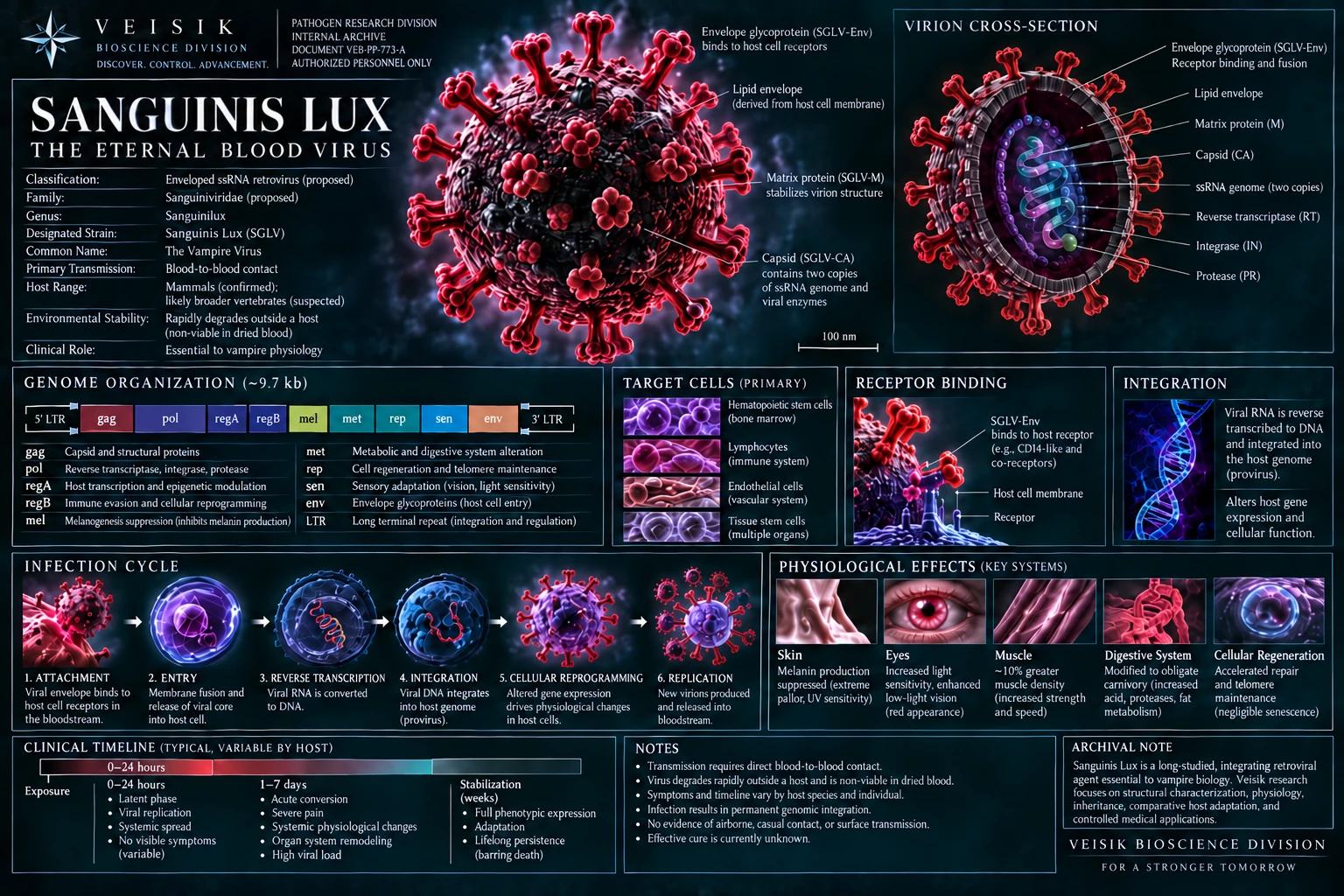
Each particle is a sphere of about a tenth of a micrometer. Its outer lipid envelope is borrowed from the membrane of the last cell it left, and it is studded with the envelope protein SGLV-Env, which locks onto receptors on a new cell and fuses the two membranes. Inside sit two copies of the RNA genome and the three enzymes the virus needs to take a cell over: reverse transcriptase, integrase and protease.
What it targets
The virus goes after the body’s long-lived, self-renewing cells, so that once they are rewritten, everything they produce is rewritten too:
- Blood-forming stem cells in the bone marrow
- Lymphocytes, the white cells of the immune system
- Endothelial cells lining the blood vessels
- Tissue stem cells in organs throughout the body
The genome
| Gene | Role |
|---|---|
| gag | Capsid and structural proteins |
| pol | Reverse transcriptase, integrase and protease |
| regA | Controls host transcription and switches genes on and off |
| regB | Hides infected cells from the immune system and drives cellular reprogramming |
| mel | Shuts down melanin production in the skin and eyes |
| met | Rebuilds metabolism and the digestive system |
| rep | Cell regeneration and telomere maintenance |
| sen | Sensory adaptation: vision and light sensitivity |
| env | Envelope proteins for entering host cells |
| LTR | Long terminal repeats at both ends, which control integration and regulation |
How it spreads
Sanguinis Lux is fragile outside the body. Its envelope breaks down quickly once it leaves living blood, so infection needs direct, fresh blood-to-blood contact: infected blood from a vampire entering another person’s bloodstream or open tissue.
| Route | Transmits the virus? |
|---|---|
| A vampire’s living blood entering a person’s bloodstream or an open wound | Yes |
| From vampire parents to their children | Yes, the virus is inherited (see Born vampires) |
| Breath, coughing or shared air | No |
| Touch or skin-to-skin contact | No |
| Dried blood, surfaces and objects | No |
The change
Every infection follows the same broad course. As with any virus, the timing and severity vary from one person to the next; the stages below are typical, not fixed.
- 0 to 24 hoursLatent phase
No visible symptoms. The virus multiplies and spreads through the bloodstream, entering its target cells and writing itself into their DNA.
- Typically 1 to 7 daysAcute conversion
The change itself. Once enough of the body is infected, the virus begins rewriting it all at once. Converts describe it as burning alive from the inside. Organs are remodeled, new teeth force their way up through the gums and push out the old ones, and the irises turn crimson. Vomiting dark blood, fever, tremor and severe exhaustion are common. The virus is at its highest level in the blood.
- Days to weeksStabilization
The new body settles into its final form and the Convert adapts to it: new hunger, new senses, new strength.
What it does to the body
| System | Change | What it means |
|---|---|---|
| Skin | Melanin production stops completely | Vampires are extremely pale and have no natural protection from ultraviolet light. |
| Hair | Varies from person to person | Some vampires lose their hair, its color or both; others keep their natural hair entirely. Loss is more common in males than in females. |
| Eyes | Pigment is lost from the iris and the pupils open wider | The iris turns crimson. Night vision is excellent, but glare is painful. On the surface, vampires hide their eyes behind dark glasses or colored contacts. |
| Teeth | A new set erupts, with longer, sharper canines | Fangs. They break through the gums during the change and force out the old teeth. |
| Blood | Hemoglobin is unstable and breaks down quickly | Vampire blood is dark, near black in most cases, and must be constantly replenished (see Why vampires need blood). |
| Digestion | Rebuilt for obligate carnivory, with more stomach acid, more protein- and fat-digesting enzymes, and a gut that absorbs heme iron with great efficiency | Vampires live on blood and flesh. |
| Muscle | Protein synthesis and testosterone rise; muscle density increases by about 10% in males and 2–5% in females | Stronger and faster than a human, but not superhuman. The rise in testosterone is greater in males, and it can also make a vampire more aggressive. |
| Repair | Damaged cells are replaced quickly and accurately | A wound that takes a human a week to heal closes in about half that time. |
| Aging | Telomeres are maintained and cell wear slows dramatically | Children still grow up. Once mature, a vampire ages very slowly and can live for centuries. They can still be killed. |
Why vampires need blood
Hemoglobin is the protein that carries oxygen in the blood, and it depends on iron to do it. In a vampire, that hemoglobin is unstable. Its iron oxidizes quickly into a form that can no longer hold oxygen, and the damaged molecules are cleared from the body far faster than in a human. Much of that iron is lost rather than recycled, so a vampire runs chronically short of it.
That shortage is what makes vampire blood look so different. Short of iron, and with much of its hemoglobin oxidized, it lacks the bright red of healthy human blood. In most vampires it is dark, almost black.
To keep enough working hemoglobin, a vampire needs a steady supply of fresh iron. Plants and water cannot provide it in any useful amount. Blood and red meat can: they are rich in heme, the iron-carrying core of hemoglobin, and a vampire’s rebuilt gut absorbs heme whole, far more efficiently than a human’s ever could. Blood is the richest and fastest source, which is why vampires drink it the way humans drink water.
Without it, iron and working hemoglobin fall, and the brain is starved of oxygen. This is the path to going feral.
Sunlight
Melanin is the body’s own sunscreen. Sanguinis Lux switches it off in the skin for good, and nothing takes its place, so ultraviolet light reaches unprotected tissue unopposed. It is one of the reasons the Empire was built underground.
- Overcast or indirect light
Glare and discomfort. Heavy cloud takes the worst of it, and a vampire who is covered up and wearing dark glasses can move under it, though never comfortably.
- Direct sun, seconds
Exposed skin burns within seconds: reddening, then blistering.
- Direct sun, minutes
The burns deepen and spread faster than even vampire healing can close them. The eyes are damaged.
- Prolonged exposure
A form of radiation sickness sets in: weakness, vomiting, collapse and widespread damage to cells throughout the body. It is often fatal. Those who survive are at risk of runaway malignant growth later.
The danger is the ultraviolet light, not the daylight. Any clothing or material that blocks UV protects the skin beneath it, from an ordinary coat to UV-filtering glass. Light that finds a gap still burns.
Hunger and going feral
The virus rebuilds the body to run on blood and flesh, and that body cannot go without them. A vampire starved for too long loses its mind before it dies. This is called going feral: the vampire becomes little more than a crazed animal that attacks anything it finds. Thousands go hungry in the Underworld every day, and ferals haunt the utility tunnels beneath the cities.
A feral’s bite can pass on Hemofames, commonly called Blood Hunger. It starts as burning at the wound, then fever and shakes, then hallucinations, seizures and an urge to feed on anyone nearby. Untreated, the skin blackens and rots, and death is slow. Anti-Feral, given by auto-injector, stops it and works best alongside food and blood. Apothecaries stock it, at prices many cannot pay.
Born vampires
The virus writes itself permanently into the genome and is thus passed on from parent to offspring. Vampire children are born carrying the virus and never go through the change that Converts do.
Animals
Sanguinis Lux is not limited to humans. Most animals can be infected, and they show the same changes people do: pale or hairless skin, red eyes that catch the light, heavier muscle and a predator’s teeth.
Treatment
There is no cure. Once the virus has integrated into the genome, it cannot be removed, and no one knows how to return a vampire’s body to its human state. Care during the change is supportive: pain relief, monitoring and rest. House Veisik continues to study the virus for medical use.
Common misconceptions
- “Vampires burst into flames in the sun.”
- They burn, badly and fast, and long exposure brings a radiation sickness that often kills. There is no fire.
- “Vampires cast no reflection.”
- They do, crimson eyes and all.
- “Vampires only come out at night.”
- Vampires avoid ultraviolet light, not the daytime. Covered up, or under heavy cloud, they can move by day.
- “Vampirism is a curse.”
- It is a virus. In the words of one who knew both worlds:
The vampires use science, not sorcery.
The Veisik plate
The Pathogen Research Division’s full summary of the virus: structure, genome, target cells, infection cycle, effects on the body and the clinical course of the change. Tap the plate to enlarge it, or open the full-size image to zoom in on a phone.